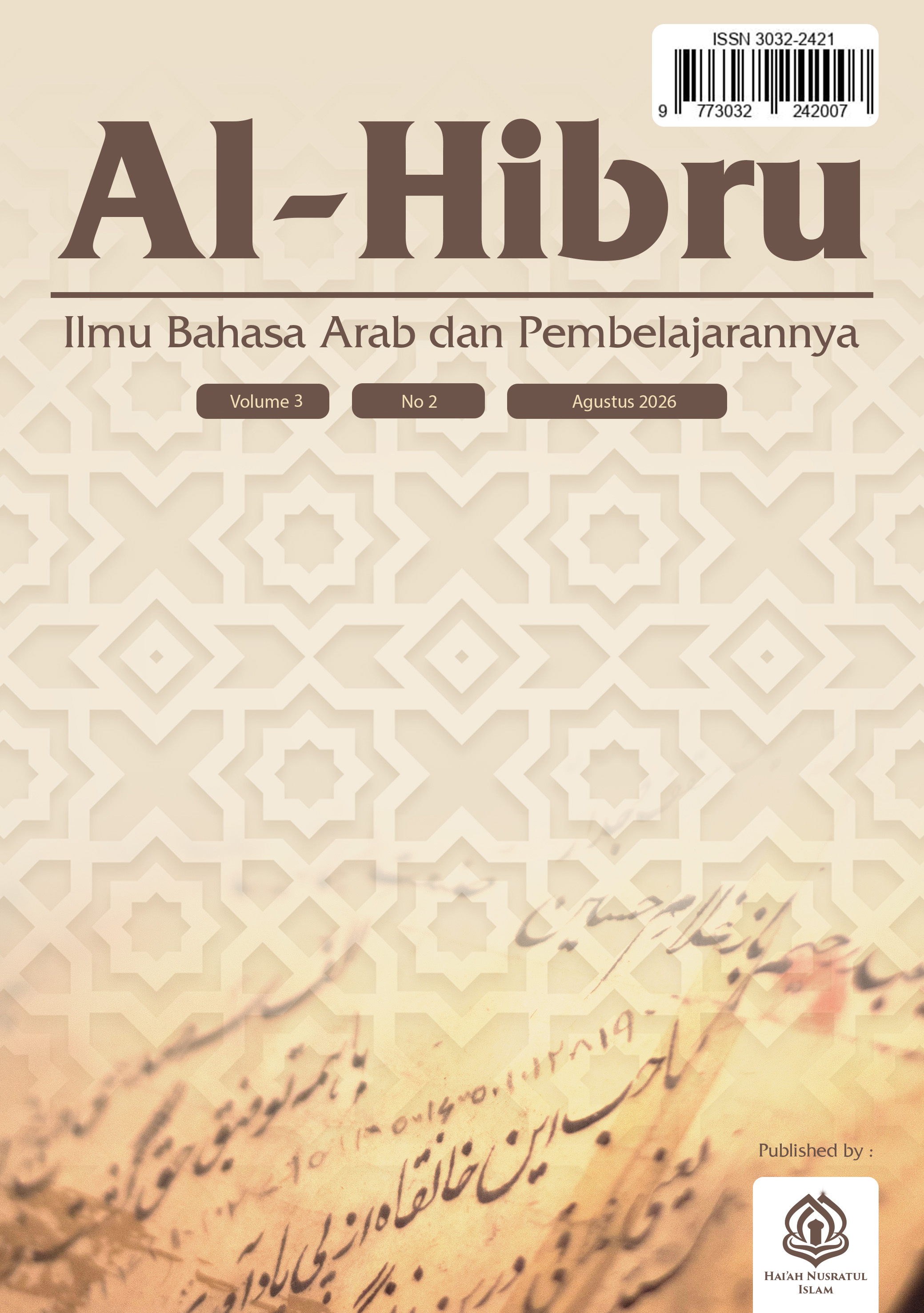
Inovasi Strategi Pendampingan Humanis pada Program 'Yaumul Arabi' Berbasis Metode Imersif bagi Siswa Non-Asrama
Authors
-
 Maula Nada Munthe
 Universitas Islam Negeri Sumatera Utara Medan, Indonesia
-
Teguh Wahyu Wicaksono
Universitas Islam Negeri Sumatera Utara Medan, Indonesia
DOI:
https://doi.org/10.59548/hbr.v3i2.746Abstract
The establishment of conventional language environments (biah lughawiyyah) often stagnates and triggers language anxiety among students due to repressive monitoring systems, such as spying (jasus) and rigid sanctions. This study aims to examine the reconstruction of the Yaumul Arabi program through innovative humanistic mentoring strategies and to measure its effectiveness in boosting students' confidence within non-boarding educational institutions. The research method employs a literature review integrated with a qualitative reflective approach (autoethnography). The results indicate that the humanistic approach effectively lowers learners' affective filters through three main stimulants: casual conversation (al-hiwar al-bashiith) to trigger confidence, the integration of behaviorist theory-based language games (al-ab al-lughawiyyah) to enrich vocabulary effortlessly, and the optimization of peer tutoring to break down psychological formalities. Despite the constraints of limited face-to-face interaction in non-boarding settings, this innovation can be modernly implemented through a hybrid approach utilizing digital ecosystems. This study concludes that a pressure-free, language-friendly atmosphere stimulates intrinsic motivation and speaking fluency (maharah kalam). Future researchers are encouraged to conduct true experimental studies to test the empirical effectiveness of this formula on a broader scale.
 References
A, N. I. (2010). Pembelajaran Hibrida Sebagai Strategi Model Pembelajaran Masa Depan. Masyarakat Telematika Dan Informasi, 1(2), 119–130. Https://Www.Neliti.Com/Publications/233731/Pembelajaran-Hibrida-Sebagai-Strategi-Model-Pembelajaran-Masa-Depan#Cite
Afifah Azkiyah, Wahyu Hidayat, D. Indriana. (2025). Pengaruh Lingkungan Berbahasa Terhadap Ketrampilan Berbahasa Arab. Alfihris: Jurnal Inspirasi Pendidikan, 3(1), 90–97. Https://Doi.Org/Https://Doi.Org/10.59246/Alfihris.V3i1.1159
Amanah Noor Pauseh, Nanda Nurul Azmi, A. P. (2022). Analisis Faktor-Faktor Kesulitan Belajar Bahasa Arab Serta Solusinya Untuk Meningkatkan Hasil Belajar. Armala: Jurnal Pendidikan Dan Sastra Bahasa Arab, 3(1), 47–56.
Anna Nurbaiti, R. H. (2023). Systematic Literature Review (Slr) : Peran Lingkungan Bahasa Dalam Meningkatkan Keterampilan Siswa Berbahasa Arab. Kilmatuna: Journal of Arabic Education, 03(01), 1–11.
Firmansyah. (2023). Pertanggungjawaban Pidanaaparatpenegak Hukum Yang Melakukantindakan Represif Terhadap Masyarakatyang Melakukan Aksi Demonstrasi [Universitas Nasional]. Http://Repository.Unas.Ac.Id/Id/Eprint/6600
Lasawali, A. A. (2020). Bahasa Arab: “Ruh” Pendidikan Islam. Loghat Arabi: Jurnal Bahasa Arab & Pendidikan Bahasa Arab, 1(2), 11–21. Https://Uinsaid.Ac.Id/Berita/Pentingnya-Belajar-Bahasa-Arab-Dalam-Islam
Miolo, M. I. (2023). Kajian Teoritis Pemerolehan Bahasa Pertama Dan Kedua. ’Ajamiy: Jurnal Bahasa Dan Sastra Arab, 12(2), 525–542. Https://Doi.Org/10.31314/Ajamiy.12.2.525-542.2023
Mochamad Abdi Fajariyanto, I. F. (2024). Strategi Pembentukan Lingkungan Berbahasa Arab Di Mts Al Irsyad Tengaran 7 Kota Batu. Jiip: Jurnal Ilmiah Ilmu Pendidikan, 7(4), 3747–3752.
Muhammad Nursalam, Fachrul Ghazi, D. (2026). Praktik Urgensi Penerapan Muhadatsah Dalam Meningkatkan Keterampilan Berbahasa Arab Di Mts Nu Bandar Lampung. Jurnal Tahsinia, 7(6), 882–892.
Pramadanti, R. (2025). Self-Confidence, Vocabulary, And Learning Motivation As Determinants of English-Speaking Ability. Matai: Internasional Journal of Language Education, 6(1), 48–63. Https://Doi.Org/Https://Doi.Org/10.30598/Matail.V6i1.22500
Pratiwi, N. S. (2022). Pendekatan Dakwah Di Tengah Heterogenitas Agama Di Kampung Serupa Indah Kecamatan Pakuan Ratu Kabupaten Way Kanan [Uin Raden Intan Lampung]. Https://Repository.Radenintan.Ac.Id/Id/Eprint/20558
Rini Astuti, Akla, A. S. (2020). Strategi Pembentukan Lingkungan Berbahasa Arab Di Madrasah Aliyah. An Nabighoh: Jurnal Pendidikan Dan Pembelajaran Bahasa Arab, 22(01), 17–36.
Ubadah. (2023). Pentingnya Belajar Bahasa Arab Dalam Islam. Uinsaid Surakarta. Https://Uinsaid.Ac.Id/Berita/Pentingnya-Belajar-Bahasa-Arab-Dalam-Islam
Wahyudin, Y. M. (2021). Mengkritik Diri Sendiri: Sebuah Auto- Etnografi Dari Pengalaman Penelitian ‘Bersama’ Anak-Anak Tuli. Icodie: The Indonesian Conference on Disability Studies and Inclusive Education, 2, 127–148.
Widiarsa. (2019). Kajian Pustaka (Literature Review) Sebagai Layanan Intim Pustakawan Berdasarkan Kepakaran Dan Minat Pemustaka. Media Informasi, 28(1), 111–124.
Downloads
Published
How to Cite
Issue
Section
License
Copyright (c) 2026 Maula Nada Munthe, Teguh Wahyu Wicaksono

This work is licensed under a Creative Commons Attribution 4.0 International License.
- Share — copy and redistribute the material in any medium or format for any purpose, even commercially.
- Adapt — remix, transform, and build upon the material for any purpose, even commercially.
- The licensor cannot revoke these freedoms as long as you follow the license terms.
Under the following terms:
- Attribution — You must give appropriate credit , provide a link to the license, and indicate if changes were made . You may do so in any reasonable manner, but not in any way that suggests the licensor endorses you or your use.
- No additional restrictions — You may not apply legal terms or technological measures that legally restrict others from doing anything the license permits.
Notices:
You do not have to comply with the license for elements of the material in the public domain or where your use is permitted by an applicable exception or limitation .
No warranties are given. The license may not give you all of the permissions necessary for your intended use. For example, other rights such as publicity, privacy, or moral rights may limit how you use the material.







 Based on a work at